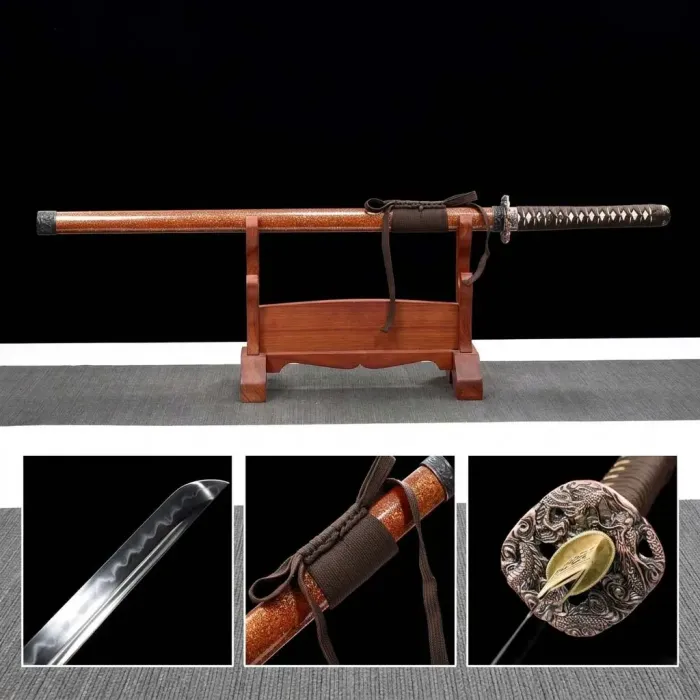
Every venerable ancient blade functions as a remarkable expression of ingenuity, but consider if you desire to communicate your exclusive approach? Refining your armament is a insightful journey, allowing you to create a truly uncommon piece. From the handle wrapping and fastening to the tsuba design and cutting motif, each segment offers a chance for bespoke design. This exploration delves into the domain of katana transformations, providing details for both initiates and experienced enthusiasts wanting to establish their trace on the ancient art of the samurai.
Introductory Genuine Creation
For beginners wanting to embark on the gratifying journey of Japanese swordsmanship , 1060 steel katanas deliver an prime entry point. This specialized grade of carbon steel meets a golden mean between budget-friendliness and performance . While not quite as hard as superior-grade steels, 1060 grants a moderate level of sharpening , making it appropriate for newcomers to acquire the foundations of blade preservation and appreciate the elegance of traditional Japanese weaponry. It’s a great choice for acquiring experience without the monetary burden of more complex steels.
Ten Ten Steel Cutting Tools : Managing Efficiency and Budget
Enabling fans seeking an authentic weapon experience without surpassing the bank , T10 steel katanas represent a promising option. These weapons offer a significant improvement in robustness compared to inferior alternatives, exhibiting satisfactory edge retention and tolerable flexibility for basic chopping techniques. While not rivaling the premium characteristics of more refined steels like T100 or folded steel , T10 provides a effective blend of effectiveness and reasonableness , making them a trendy choice for students and those on a restrained income .
Moving beyond the Keel : Tailoring Your Cutting Weapon's Fittings and Grasp
Whereas the sharpened blade is undeniably the important point of a katana, truly improving its presence lies in the exact customization of its details and handle . This process allows craftsmen to reveal their unique approach . Reflect on the vast possibilities: menuki - decorative embellishments that add visual charm ; the hamon encasements – often delicately carved ; the tsuka heart itself, wrapped in time-honored ito braid ; and the fusa stopper , which can be formed from various fabrications like bullion or horn .
- Elect themes that correspond with you.
- Try with alternative substances .
- Value craftsmanship for a lasting consequence.
The Love of the Katana: Antiquity, Formation, and Composition
A oriental cutlery shows a distinctive allure, steeped in eras of Japanese history and legacy . More than merely a artificial item of warfare , it's a icon of the soldier ethos – a fusion of skill and restraint . Its maturation spanned score generations, with early swords evolving into the sleek curvature and precise edge we recognize today. The creation involved is truly amazing , requiring eons of apprenticeship to attain . The process involves a detailed folding of wrought steel , creating layers that amplify the sword’s flexibility and cleaving ability. Several schools of manufacturing developed , each with their particular secrets and styles for achieving the finest symmetry and cleanness - a truly heavy pursuit.
- Early Katana forms
- The function of the nihonto in fighter culture
- Heritage blacksmithing systems
Electing the Right Steel for Your Armament Project: 1060 vs. T10
Determining the favorable steel is essentially important for any cutlery project, and the conclusion between 1060 and T10 can be tricky. 1060 is a frequented American element, offering a competent balance of rigidity and persistence, supplying it comparatively custom katana easy to forge. However, T10, a Oriental steel, generally boasts enhanced wear endurance and can possibly achieve a higher final hardness, although it can be relatively laborious to treat and requires thorough heat annealing. Consider your expertise and intended outcomes: for a trainee, 1060 may be a safer launchpad, while the seasoned smith might favor the additional details of T10.
- Manageability of Applying
- Abrasion
- Ultimate Toughness
Unlocking the Potential: Advanced Katana Customization Techniques
Excelling in the craft of sword improvement extends far beyond basic finishing. Serious practitioners are now analyzing advanced techniques to truly discover a blade's hidden potential. This entails intricate work with the hamon, utilizing specialized products for differential heat treating and carefully nominating the contour of the hand guard to optimize balance and functionality. Beyond purely functional changes, artisans are increasingly focused on achieving unparalleled aesthetic style, through complex engraving and layered glazes that truly transform a katana into a showpiece.
Turning Raw Material into Excellence: Creating a 1060 Katana
The journey embarks with typical 1060 substance, a hard material far from the sophisticated katana it will become . Expert bladesmiths perform a complicated process of uniting and molding the primary steel, repeatedly warming it and impacting it to remove impurities and generate a stable grain structure. This painstaking process, often spanning for days , builds the crucial force and give characteristic of a bona fide Japanese tool. Subsequent heat adjustments , including careful hardening and quenching , are necessary to achieve the expected equilibrium of sharpness, permanence and splendor .- Folding: Eliminates impurities and produces grain structure.
- Fabricating: Shapes the steel into the initial blade form.
- Quenching: Establishes the final hardness and flexibility.
The Persistent Magnetism of the Katana: Thorough Examination of Alloy and Modification
That long-standing katana survives a powerful symbol within Japanese tradition , its attraction far overtopping mere arms and armor . Forged from traditional steel and often featuring intricate patterns , the technique of creation itself is a respected art. Beyond the foundational craftsmanship, the ability to personalize a katana - from the hamon to the hilt wrapping and clasp - affords for a sincerely individual demonstration for both worshippers and followers alike. This confluence of classical steelwork and boundless personalization creates the katana's continued widespread acceptance across the universe.